
How Long Can a Battery Run a Refrigerator?
A portable power station runs a typical full-size refrigerator for roughly six to twenty-five hours, depending on its capacity. The sum is capacity in watt-hours, minus about fifteen per cent for inverter losses, divided by the fridge's average draw — about 150 W for a full-size model once the compressor is cycling. A 2,073.6 Wh station comes to roughly 11.8 hours.
The short version
- The sum
- watt-hours × 0.85 ÷ average watts = hours
- A full-size fridge averages
- about 150 W once the compressor cycles on and off
- Starting it needs more
- a compressor pulls roughly three times its running draw for an instant
- 1,000 Wh gets you
- about 5.7 hours at that draw
- 2,000 Wh gets you
- about 11.3 hours at that draw
- What breaks the estimate
- a warm room, an old seal, a door that keeps opening
Why the number on the box does not answer the question
A power station carries two numbers and they answer two different questions. Watts — the output — decide whether it can run the appliance at all. Watt-hours — the capacity — decide for how long. A station with a big output and a small battery starts your fridge and then dies in an hour; the reverse will not start it at all.
A refrigerator makes this worse, because it does not draw a steady figure. The compressor runs, reaches temperature, stops, and starts again when the box warms. What matters for runtime is the average over those cycles, which is well under the figure printed on the appliance label. What matters for starting is the opposite: an instantaneous spike of roughly three times the running draw as the motor turns over.
So a fridge can defeat a power station in two entirely separate ways. It can want more power than the inverter can deliver at the instant the compressor kicks in, or it can simply outlast the battery. The calculator below answers both, and prints the arithmetic so you can put your own appliance's numbers through it.
Work it out with real capacities
The models below are BLUETTI's, because their published capacities are the ones we have read and dated. The arithmetic is the same for any brand: take the watt-hour figure, take fifteen per cent off it, and divide by your draw.
| Model | Capacity | Output | Hours at 150 W |
|---|---|---|---|
| Elite 10 Mini | 128 Wh | 200 W | ~0.7 h |
| Elite 30 V2 | 288 Wh | 600 W | ~1.6 h |
| AC180 | 1,152 Wh | 1,800 W | ~6.5 h |
| Elite 200 V2 | 2,073.6 Wh | 2,600 W | ~12 h |
| Apex 300 | 2,764.8 Wh | 3,840 W | ~16 h |
| Elite 300 | 3,014 Wh | 2,400 W | ~17 h |
| Elite 400 | 3,840 Wh | 2,600 W | ~22 h |
Capacities and outputs in that table are BLUETTI’s own published figures, read on 2026-09-10. Check the current range on their site
How long will one of these run your things?
Pick what you need to keep alive and for how long. The answer is an estimate, not a measurement: that model’s watt-hours, minus 15% for inverter losses, divided by the draw we assume. The arithmetic is printed with every result so you can put your own numbers through it.
The label is usually on the back or inside the door. If it gives amps, multiply by 120 in the US.
Read these as estimates. The draw is a typical figure, not your appliance: a large American refrigerator and a small European one differ by a factor of two, and a compressor cycles on and off, so its average depends on the room temperature, how often the door opens and how old the seals are. We remove 15% for inverter losses; the real figure varies with load. And matching the running watts is not enough to start a motor: a fridge, a freezer, a sump pump or an air conditioner pulls roughly three times its running draw for the first instant, which is what the surge column is about. Check the label on your own appliance before you rely on any of this.
What to get for your situation
Match the row, not the marketing.
- The power goes for two or three hours, once or twice a year
- A cooler and some ice is a rational answer. If you would rather not think about it, 1,000 Wh covers it comfortably.
- Outages last most of a day, a few times a year
- 1,000 to 1,500 Wh runs the fridge through it. Keep the door shut and it will do better than the sum says.
- You want the fridge covered overnight, and the router with it
- About 2,000 Wh. That is roughly twelve hours on the fridge alone, and the router costs almost nothing on top.
- Fridge and a chest freezer
- Assume 250 W rather than 150 W, which halves every figure on this page. 3,000 Wh or an expandable unit.
- Somebody in the house uses a CPAP
- Work that out separately and add it: about 40 W without the humidifier, roughly double with it. It is the load that actually has to survive the night.
- Storm season, and outages measured in days
- No battery alone answers this. Either a station you can recharge from solar during the day, or a fuel generator — the comparison is its own guide.
What we would buy for the overnight fridge
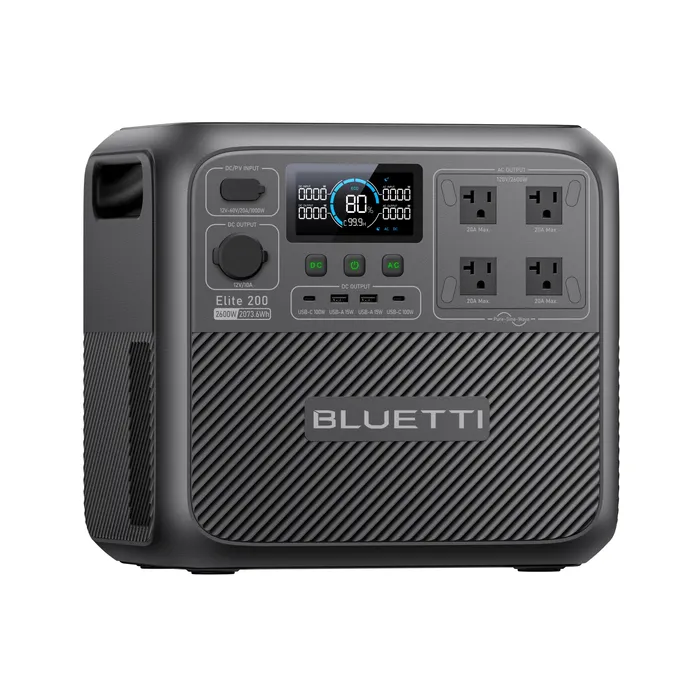
For the case most people are actually asking about — keep the refrigerator alive through a night, indoors, without storing fuel — the size that fits is about 2,000 Wh with an output comfortably above a compressor's surge.
- 2,073.6 Wh of capacity, which is about 11.8 hours at a 150 W average, by the same sum printed above.
- 2,600 W of continuous output, against the roughly 450 W instant a 150 W compressor asks for when it starts.
- No exhaust, so it can sit in the kitchen rather than outside in the rain. BLUETTI publishes 16 dB of fan noise under low load.
- It recharges from solar, which is what turns a one-night answer into a multi-day one.
Where this is the wrong answer. If your list is a fridge and a chest freezer together, this is not enough and we would rather say so here than after you have bought it. Read the row above and size up.
The full BLUETTI page — the whole range, who should skip it, and what a return costs
What else answers this
A fuel generator
Runs as long as you keep feeding it, which is the one thing a battery cannot do. It also lives outdoors, needs oil and stored fuel, and produces carbon monoxide. Battery versus generator, side by side.
A cooler and ice
Unglamorous, cheap, and genuinely correct for a household that loses power for three hours once a year. A full freezer holds its temperature for a day or so if the door stays shut.
A smaller station and a shorter list
If the real fear is the router and the phones rather than the food, the size drops by a factor of five and so does what you spend.
Questions people ask
Will a power station actually start my refrigerator?
It depends on the output, not the capacity. A compressor pulls roughly three times its running draw for the instant it starts, so a fridge averaging 150 W wants something in the region of 450 W available at that moment. Anything above about 1,000 W of continuous output has margin; a 200 W unit does not, however large its battery.
Can I run one indoors?
Yes. There is no engine and no exhaust, which is the reason most people choose one over a generator. It has a cooling fan, and a fan gets louder as the load rises.
What happens if the outage lasts longer than the battery?
Two things stretch it. A solar panel recharges during daylight, which can turn a twelve-hour battery into an indefinite one in the right weather. And a fridge does not need to run continuously: powering it in cycles, with the door shut, keeps food cold on a fraction of the energy.
Does opening the door matter?
More than anything else on this page. Every opening replaces cold air with room air and the compressor has to run again. During an outage, the single most effective thing you can do is decide what you want before you open the door.
Why take fifteen per cent off the capacity?
The battery stores direct current and your fridge wants alternating current, so an inverter converts it and loses some as heat. Fifteen per cent is a reasonable working assumption rather than a measurement; the real figure moves with the load.
If you have decided
Everything above is the reasoning. If it landed where we think it does, this is the model it points at — and the full BLUETTI page has the whole range, the return terms and the people who should skip it.
Sources and method
Every runtime on this page is arithmetic, not a measurement: a published capacity divided by an assumed draw. We have not had one of these on a bench. The capacities are read from the merchant's own product pages on the date below; the draw figures are assumptions, and they are stated as assumptions everywhere they are used.
- Capacity, continuous output, surge and fan noise for every model in the table
- bluettipower.com, the product page for each model
- The 150 W average for a full-size refrigerator, the 40 W CPAP and the rest of the appliance list
- Our own working assumptions, printed with every result the calculator gives
- The fifteen per cent deduction for inverter losses
- A working assumption, not a manufacturer figure
Checked on the merchant’s own pages: 10 September 2026.