
AI E-Commerce Automation
Build Your Product Engine
Most AI courses show you prompts. This course shows you how to connect AI, product data, pricing logic, APIs, validation rules and automation into a practical e-commerce workflow you can run end to end on your own computer.
Get the course on Gumroad Opens our Gumroad page, where the price and the 7-day refund terms are.- Python 3.10+
- 35 automated tests
- 30-product practice catalog
- Starter code + 9 checkpoints
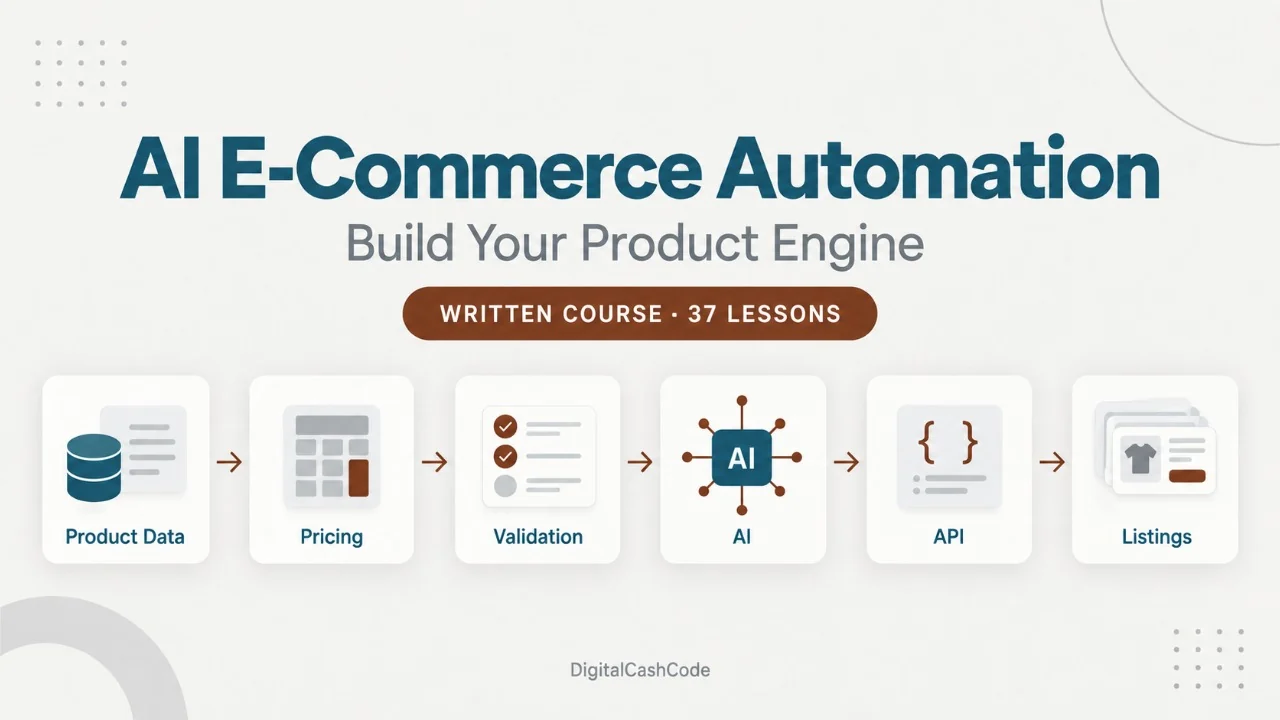
What you will build
You build one complete system, lesson by lesson, on one 30-product practice catalog. At the end, a single command takes that catalog from raw supplier data to Shopify, eBay and Amazon listings on a local mock marketplace API (nothing is sent to a real store), stops every product that fails its checks, and tells you why.
- Import a supplier catalog and normalize messy titles, units, colors, sizes, weights and GTINs
- Reject bad source data before it costs you anything
- Calculate a floor price for each marketplace, and sell at the market price when the market pays more
- Validate GTINs, category requirements and required attributes
- Generate listing content with an offline AI stand-in (not a language model) or, optionally, a live AI model (not tested with a real API key), then check it word by word against the supplier facts before it moves forward (a guardrail, not a guarantee)
- Turn one internal product into Shopify, eBay and Amazon payloads
- Hold a product on one marketplace while it still sells on the others
- Publish to a mock marketplace API with dry runs, token refresh, retries, and a check on the marketplace before re-sending, to avoid duplicate listings when a response gets lost
- Ask each mock marketplace what it actually holds, and repair what went missing
- Route each blocked product and held listing to a human review queue with the reason and a suggested fix, and log each stage's decision in an audit file
The goal is not to remove humans from the process. It is to automate repetitive work while keeping important business decisions under your control.
The 9 modules
Each module starts from the starter code or the previous checkpoint and ends with a check you can run to confirm your project matches the lesson.
Build the Automation Foundation
Run the finished system first, set up the project, load the 30-product practice catalog, and build your first working pipeline.
Normalize Messy Product Data
Turn inconsistent supplier data into a clean canonical product model. Normalize titles, text, colors, sizes, weights and GTINs, and reject bad source data early.
Build the Profitability Engine
Calculate landed cost, import duty, shipping, marketplace fees, target margin and a floor price for each marketplace. Then use that floor as a minimum instead of underpricing products below their market value.
Validate GTINs, Categories & Required Attributes
Catch missing or invalid GTINs, category requirements, missing attributes and other deterministic listing problems before spending money on AI or sending anything to an API.
AI Enrichment with Deterministic Grounding Guardrails
Generate structured titles, bullets, descriptions and attributes from known product facts, then check them against the supplier facts before they can move forward. These checks compare words, not meaning, so they can’t catch every false claim: they are a guardrail, not a guarantee, and a person reviews what they hold.
One Product, Three Marketplace Payloads
Use the adapter pattern to transform one canonical product into marketplace-specific payloads for Shopify, eBay and Amazon without duplicating your core business logic.
OAuth, APIs & Safe Publishing
Learn access-token refresh, API request handling, dry runs, payload validation and safe publishing using a reproducible mock marketplace API.
Errors, Idempotency, Retries & Human Review
Handle 400, 401, 429, 5xx and timeout responses, retry temporary failures, avoid duplicate listings when a response is lost, and route unresolved products into a human-review workflow.
Run the Complete Product Engine
Process the full 30-product catalog from raw supplier data to listings on the mock marketplaces, confirm what each mock marketplace holds, inspect the audit trail, correct the review queue, rerun safely, and verify the final system with automated tests.
What is included
There are no fake testimonials, income promises or “make money overnight” claims here. You are buying a technical, practical course about building e-commerce automation.
- 9 modules, 37 step-by-step written lessons: the real code, the exact commands to run, and the output you should see
- Starter code, 9 module checkpoints, and the complete source code of the finished system
- The 30-product practice catalog, with deliberate real-world defects to find and fix
- A pricing and margin engine with editable fee profiles for each marketplace
- A mock marketplace API that simulates real failures: an expired token, a rate limit, a lost response
- An offline AI stand-in that builds listing text from the supplier facts and adds one typical AI mistake for you to catch
- 35 automated tests that check your system as you build it
- Any corrections or updates to the course materials, at no extra charge
Who this is for
- E-commerce and marketplace sellers
- Developers and technical entrepreneurs
- AI automation builders
- Freelancers building automation for clients
- People managing large product catalogs
- Sellers who want to reduce repetitive product-listing work
Who this is not for
- You want guaranteed income
- You are looking for a dropshipping "get rich quick" course
- You expect AI to run a business with zero human supervision
- You want a Python-from-zero course
- You want a completely no-code course
Requirements
This is a hands-on technical course. You do not need to be an advanced developer, but you should be comfortable with basic Python: functions, lists, dictionaries, simple classes and try/except, and running a script from a terminal. This is not a Python-from-zero course.
- Python 3.10 or newer
- A Windows, macOS or Linux computer
- A code editor (VS Code is recommended)
- Basic familiarity with CSV and JSON files
- Basic understanding of e-commerce products, costs and margins
- No paid software and no seller account: a local mock marketplace API and an offline AI stand-in let every student complete the full project at no cost and reproduce the same results
Module 5 also explains an optional live AI mode that calls Anthropic’s API with your own API key. It is not needed to complete the course, it has not been tested with a real API key, API charges are not included, and its output will differ from the lessons.
Marketplace fees, categories, product types, API requirements and platform rules change. The included configurations are teaching examples and should be verified against current marketplace documentation before using the system for real listings.
FAQ
Is the course already finished?
Yes. All 9 modules and 37 lessons are available as soon as you buy.
Is this a video course?
No. It is a written, step-by-step course. Every lesson shows the real code, the exact command to run and the output you should see, so you can follow along at your own pace and copy what you need.
Do I need to know how to code?
Yes, at a basic level: Python functions, lists, dictionaries, simple classes and try/except, and running a script from a terminal. You do not need to be an advanced developer. Harder concepts like OAuth tokens, idempotency and the adapter pattern are built up step by step.
Will this automatically make money for me?
No. This course does not promise revenue, profit, sales or business results. It teaches you how to build and understand e-commerce automation systems.
Do I need a seller account on Shopify, eBay or Amazon?
No. The whole course runs against a local mock marketplace API that simulates a few real API problems: an expiring token, a rate limit and a lost response. The payloads are modeled on each marketplace’s public API and simplified for teaching (category values are placeholders), and no client for a real marketplace API is included. Connecting a real seller account means writing a client for each marketplace, setting up its developer access, and adapting the payloads, fees and categories, which this course does not cover.
Do I need to pay for anything else?
No paid software is required. The complete core project uses only the Python standard library, and you do not need an AI API key. Module 5 also explains an optional live AI mode that calls Anthropic’s API with your own API key. It is not needed to complete the course, it has not been tested with a real API key, API charges are not included, and its output will differ from the lessons.
Will I receive future updates?
Any corrections or updates to the course materials are free for students. Major future courses or separate advanced programs may be sold separately.
What if it is not for me?
You can request a full refund within 7 days of purchase. Email [email protected].
Build the whole engine, one lesson at a time
9 modules and 37 written lessons, the complete source code and 35 automated tests, available as soon as you buy.
Get the course on Gumroad Opens our Gumroad page, where the price and the 7-day refund terms are.This course is educational material only. It does not guarantee income, sales, marketplace approval, account approval, profitability or business results. Marketplace rules, API requirements, fees and third-party services can change over time. You are responsible for reviewing and complying with the rules of any platform you choose to automate. It is not legal, tax, accounting or financial advice. The costs, fees, duty rates, prices and margins in the lessons are made-up teaching examples, not a prediction of what you will earn; check your own numbers and ask a qualified professional about taxes, duties and your legal obligations. Shopify, eBay, Amazon, Anthropic and Claude are trademarks of their respective owners. This course is independent and is not affiliated with, sponsored by or endorsed by any of them.
Privacy: this page and the Gumroad page use Google Analytics and the Meta Pixel. Details and opt-outs: digitalcashcode.com/privacy.